
Federal Bureau of Prisons Release Meaning
The BOP locator covers federal prison custody, generally for modern records from 1982 onward. BOP explains that a past release date with no current facility means the person left Bureau custody on that date. A result labeled Released has the same limited meaning: the person is no longer in BOP custody. It does not decide whether the person is physically unrestricted.
Federal supervised release can begin after imprisonment. ICE, a state, a county, or the U.S. Marshals Service can also take custody under a separate basis. The BOP record should be stated with its jurisdiction: “BOP custody ended,” followed by any verified next status. Do not turn the federal date into a Greene County jail release date.
BOP Release Records Beyond Locator
The locator is strongest when a register number, location, and past release date form a clear match. It is not a complete federal case file. The federal judgment supplies the sentence, while later court entries can show supervised-release terms or revocation proceedings. A formal BOP request should identify the person, register number, date range, and exact existing custody or release record sought. Older prison records outside the locator’s normal modern scope may require the National Archives.
A projected date should be saved with its retrieval date because recalculation can change it. A past release date with no BOP facility supports exit from Bureau custody on that date. It does not identify a Greene County jail event, resolve a state hold, or establish that federal supervision ended. Keep those claims tied to their own agency records.
Privacy limits can restrict records about another person. Ask only for material that can lawfully be disclosed and do not demand a newly created explanation. If the public result and a court document differ, preserve both dates and ask whether one reflects a projection, later correction, or separate custody event.
Federal Custody After Greene County
A person can leave Greene County custody for a federal detainer without entering BOP prison immediately. The U.S. Marshals Service manages federal court-ordered prisoners through pretrial detention, acquittal, conviction, or delivery to BOP, but it offers no public inmate locator. Use the federal detention or release order and a focused USMS FOIA request for that stage.
If the person later enters BOP, search by register number and record the facility and release field. If BOP shows a past release, review the federal docket for supervised release. When ICE is a supported next custodian, use the ICE locator, which includes current detainees and released people only within its limited recent-release window. A state or county hold requires that agency’s official system.
The sequence can therefore read Greene County transfer, USMS custody, BOP imprisonment, BOP release, and federal supervision or another handoff. Not every person passes through every stage. Report only the stages confirmed by a source, and do not fill a missing interval with an assumed community release.
Search a BOP Release Record
Open the official BOP inmate locator. Search by BOP register number when it is known because that identifier is more exact than a name. The locator also accepts DCDC, FBI, or INS numbers. A name search allows optional age, race, and sex filters, but those fields should support rather than replace a strong identity match.
- Choose number search or name search and enter the most reliable available identifier.
- Compare the complete name and register number before opening or recording a result.
- Read the release date and location together, noting whether a federal facility is still shown.
- Save the lookup date because future dates and locations can change.
- Check the federal court docket or another receiving system when supervision, a hold, or a transfer is possible.
For a named person whose custody may have stayed local or moved to Tennessee, the Greene County release guide explains the separate Sheriff and TDOC paths.
BOP Locator Release Fields
The locator presents a compact result, so each field matters. A future date is projected and can change, including through sentence recalculation. A past date identifies the recorded endpoint of BOP custody. The location field helps separate a person still assigned to a BOP facility from one with no current Bureau location.
| Field | How to use it |
|---|---|
| Name | Compare spelling and known variants. |
| Register number | Use as the durable federal prison identifier. |
| Age, race, and sex | Supporting match details, not sole proof of identity. |
| Release date | Past date marks BOP departure; future date may change. |
| Location | Shows current BOP assignment or no Bureau facility. |
A private database or news article can preserve an old entry and confuse a projection with the final date. Return to the federal source and preserve the current result.
Verify a Federal Release Beyond BOP
After confirming the BOP endpoint, inspect the federal court docket for supervised-release conditions, revocation proceedings, or another detention order. A federal judgment explains the sentence, while the BOP locator records prison status. If ICE involvement is supported, use the Online Detainee Locator System. If a state or county hold is identified, search that custodian’s official system.
A federal pretrial detainee may never appear in the conventional BOP locator. The U.S. Marshals Service manages federal court-ordered custody through acquittal or conviction and transfer, but it has no public prisoner locator. Use the federal release or detention order and, when needed, seek the existing custody or disposition record through USMS FOIA.
No BOP Prison in Greene County
No operating federal prison was verified in Greene County. A federal defendant connected to Greeneville may be held or imprisoned elsewhere, and the national locator controls the prison lookup. The facility name in the current BOP result matters more than the county linked to the underlying case.
The local Sheriff operates a jail dating to about 1997 with a stated capacity of 167 and a Workhouse dating to about 2002 with a stated capacity of 273. Those buildings are county facilities, not BOP institutions, and movement between them remains county custody. A federal transfer begins only when the county or federal record identifies the receiving authority.
A proposed BOP Residential Reentry Center became a Greeneville zoning issue in 2024. The sourced local report said the industrial-park site would not proceed and another site was needed. A proposal is not an operating facility, so it must not be added to the local detention list or used as proof of a person’s placement.
Residential reentry, home confinement, supervised release, and full discharge are different statuses. Use the exact language in the current federal record and do not infer a local placement from a plan discussed in the news.
Read the Official BOP Explanation
The BOP locator field explanation describes the scope of its federal records and the meaning of a released result. The captured official page below is a safer reference than a named person’s screenshot.
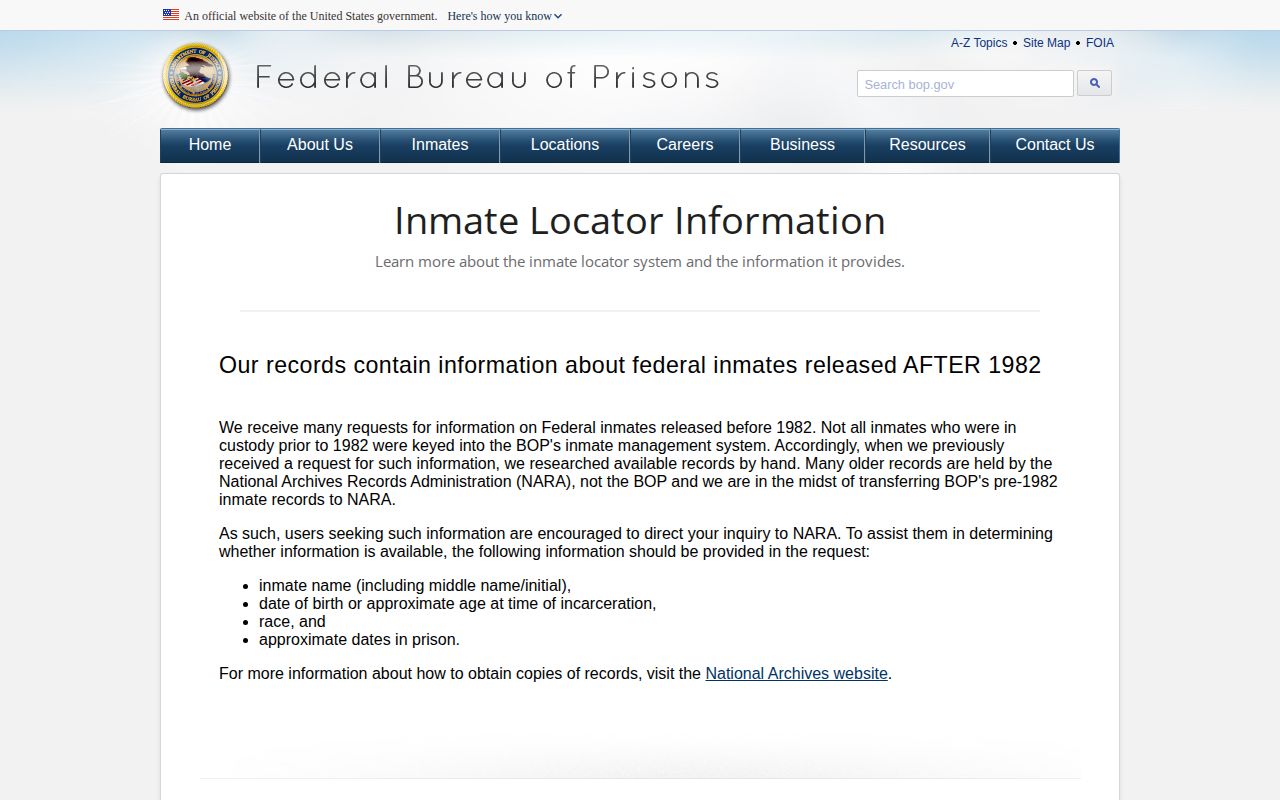
Older federal prison files outside the locator’s normal date range may require the National Archives and Records Administration. A records request should identify the person, register number if known, date range, and the precise existing record sought.
Federal Release Records and Projections
A future BOP release date is not an immutable appointment. Sentence calculations and applicable credit changes can alter it. Record the access date and avoid promising a physical release time, location, travel plan, or community placement that the official source does not provide. The research did not identify local federal release logistics for Greene County.
For an actual past event, pair the locator result with the federal judgment or release paperwork when formal proof is important. The register number, release date, and final BOP location provide a strong locator trail. Supervised-release details belong to the federal court record, and an immigration detention status belongs to ICE.
A federal release record also should not be read as a county booking history. If the same person had a Greene County custody episode before or after the federal sentence, obtain that transaction separately from the Sheriff. Keep the two agency timelines distinct, record which office supplied each date, and identify any gap rather than filling it with an assumption. This jurisdiction-by-jurisdiction method prevents a federal release date from being mistaken for the end of every pending case, hold, or supervision term.
Resolve Federal Release Conflicts
When a news report calls someone released but BOP still shows a facility, compare dates and identifiers. When BOP shows Released but ICE or a state locator shows custody, report the jurisdictions in sequence instead of choosing one. A missing USMS record online is expected because the Marshals Service has no public locator.
Do not infer that two people are the same from a shared name. Use the federal register number and other lawful identifiers. Keep date-only precision as a date and do not invent midnight. If an official record is corrected, prefer the updated agency source and retain enough retrieval context to explain the change.