
Greene County Parole and Probation
Parole and probation both allow a person to live in the community under conditions, but they begin through different legal acts. The Tennessee Board of Parole authorizes parole before a state sentence expires. Tennessee Department of Correction staff then supervise the parolee. Probation comes from a court order. It can be a direct sentence or can follow a period of split confinement. In Greene County, the judgment and later docket entries identify the court’s order, while TDOC’s public record may identify current state supervision.
Neither status is the same as being held in jail. A parole or probation entry generally points to community supervision. By contrast, an incarcerated status means custody continues. An inactive TDOC entry should not be read as active supervision, and it does not reveal the exact reason a county jail entry disappeared. Match the status to its date and obtain the court or correctional document when the distinction matters.
| Feature | Parole | Probation |
|---|---|---|
| Who authorizes it | Tennessee Board of Parole | Sentencing court |
| When it begins | Before sentence expiration, after approval and prerequisites | As ordered by the court, sometimes after split confinement |
| Who supervises | TDOC community supervision | TDOC when the judgment places the person under state probation supervision |
| Best proof | Board action, signed certificate, release transaction, and current FOIL status | Judgment or probation order, release transaction, and current FOIL status when applicable |
| How it ends | Discharge at the legal endpoint or Board action | Completion or discharge under the court’s sentence |
- Parole
- Conditional community release authorized before a state sentence expires.
- Probation
- Court-ordered community supervision that may replace or follow confinement.
- Discharge
- The formal end of a sentence or supervision term.
- Absconder
- A supervised person alleged to have stopped reporting or left supervision without approval.
- Revocation
- A formal process that can change or end community supervision after an alleged violation.
Verify Greene County Post-Release Supervision
Begin with Tennessee’s Felony Offender Information Lookup, known as FOIL. It covers people currently or formerly in TDOC custody or supervision. A name search requires a last name; a first name, race filter, or alias option can narrow a match. A TDOC ID or State ID is stronger when available. The record may report incarcerated, probation, parole, or inactive status. It may also show an office or location, sentence data, parole-hearing status, and release information.
Identity comes first. Common names can point to the wrong record. Compare the TDOC number, middle name, date of birth where shown, sentence, and Greene County case information before relying on the result. Then confirm an active parole or probation status with the office shown. A saved search screen is useful, but the supervising office and originating court hold the current records.
- Open the TDOC FOIL search and choose Name, TDOC ID, or State ID.
- Enter the strongest identifiers, use the alias option if needed, and complete the CAPTCHA.
- Open the matching person’s record and read the exact status, location, sentence, release information, and parole-hearing status.
- If the record says parole or probation, note the listed office and call it to verify current supervision.
- Use the Greene County court judgment or probation order to confirm how the supervision began.
- Request the Board decision, certificate, discharge letter, or court order when documentary proof is required.
For the full county release transaction and court path, the Greene County released-inmate search explains how the jail record and court order fit beside FOIL.
Note: A parole grant is not proof of physical release because a plan, prerequisite, rescission, or detainer can delay departure.
Greene County Supervision Office
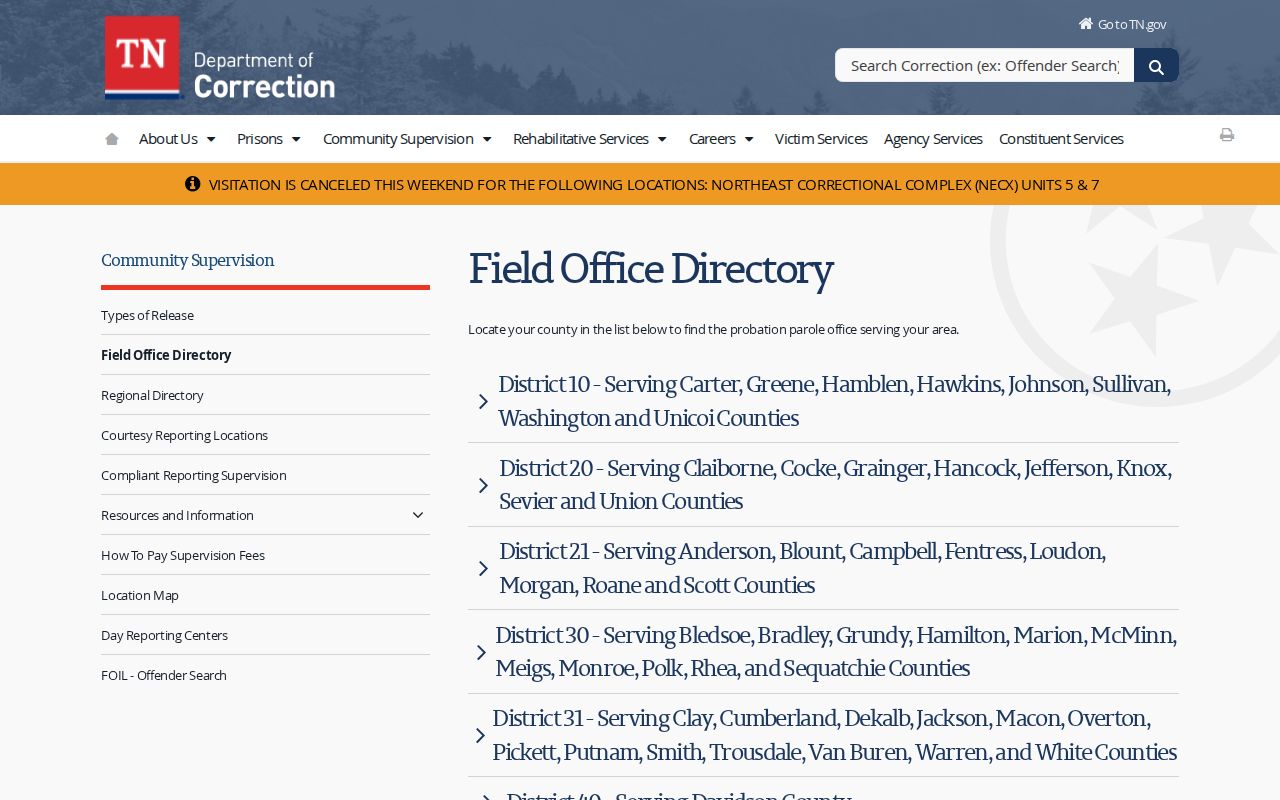
The official TDOC field-office directory places Greene County in District 10. The Greene/Hawkins field office is the local point for a record that names this office. It is appropriate to ask whether a listed status and office remain current. Staff may limit information because supervision files can contain protected details, so use the person’s full name and TDOC number and ask a narrow status question.
TDOC Greene/Hawkins Field Office
219 W. Depot Street, Suite 1
Greeneville, TN 37743
Phone: 423-638-2994
Fax: 423-638-1681
The District 10 office is in Johnson City at 195 Freckles Court and uses 423-434-6800. Call the office displayed in FOIL instead of assuming the nearest building supervises the person. A change of residence or case assignment may shift responsibility.
The official directory below shows the statewide office framework and the Greeneville listing. That context helps explain why Greene County parole and probation records point to a TDOC field office rather than the former prison.
Greene County Parole Hearing Records
The Board publishes separate hearing schedules for state prisons and county jails. Those schedules update weekly on Monday, or Tuesday after a Monday holiday. A row may show facility, TDOC ID, name, hearing type, and hearing date. If Greene County Jail does not appear in one week, the only safe conclusion is that no Greene entry was listed in that edition. Absence does not prove denial, ineligibility, or release.
Hearing officers make nonbinding recommendations. Board members may adopt, change, or reject them. Initial and review hearings address possible parole. Revocation proceedings address alleged violations after release. Custodial hearings can concern parole from one sentence to another, while pre-parole rescission can cancel a grant before departure. A schedule is not a result, and a recommendation is not final action.
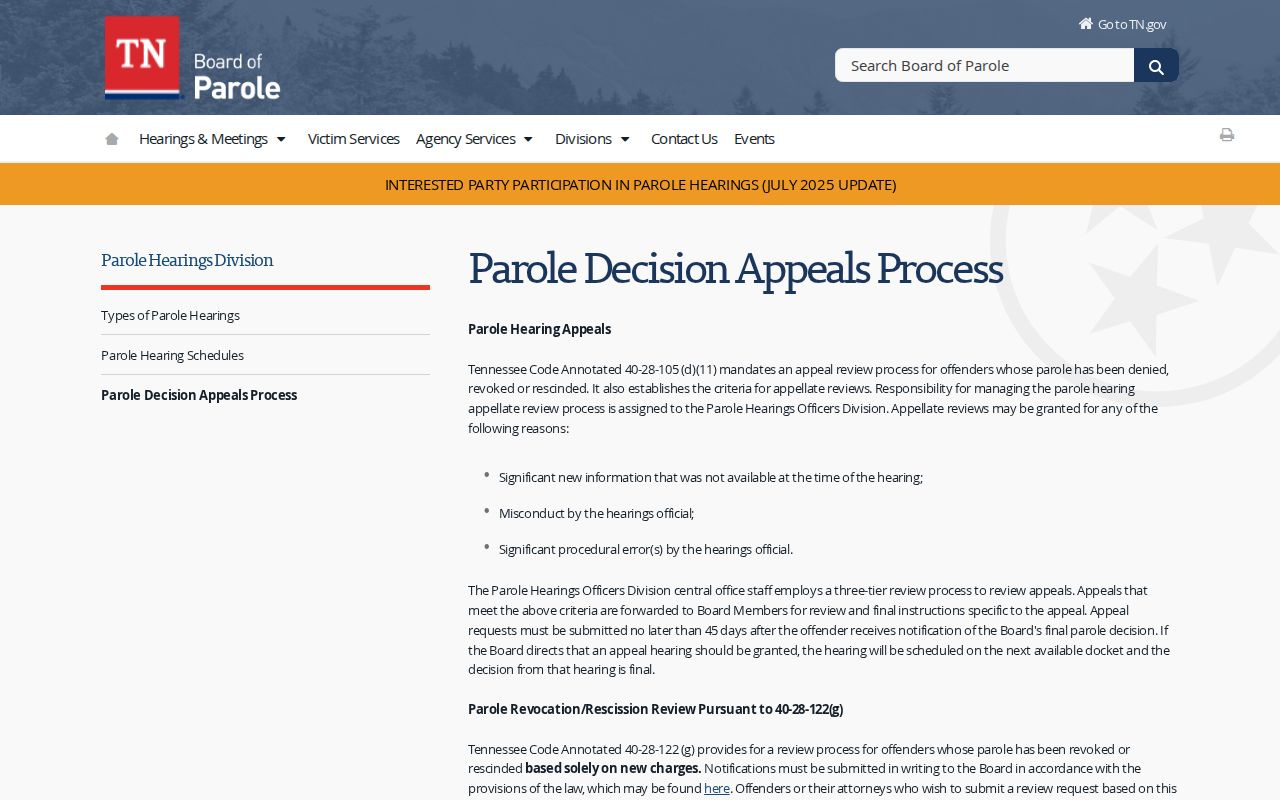
No separate statewide public decision database was found. FOIL’s parole-hearing-status field is the first person-specific result channel, after which a requester can seek the decision from the Board. The Board’s appeal process allows limited appeals of denied, revoked, or rescinded decisions within 45 days after receipt of final notice. Tennessee VINE can alert on parole eligibility, release, transfer, sentence expiration, or another custody change, but it does not prove active supervision. Verify a VINE alert in FOIL and with the listed field office.
The Board’s decision and appeal page pictured here separates an outcome from the later process of release or supervision. A final grant still needs release-plan approval and an actual TDOC release transaction.
Greene County Supervision Violations
Conditions depend on the certificate, judgment, and supervision plan. They can require reporting, approved residence or travel, compliance with court orders, and completion of assigned programs. A suspected breach can lead to a report, warrant, preliminary process, or revocation hearing. These terms describe allegations and process. They should not be treated as proof that supervision was revoked.
A capias is a court-issued order to take a person into custody. A probation-violation warrant comes through the court process, while a parole warrant and revocation process involve TDOC and the Board. A warrant can change present status without erasing a valid earlier release date. Likewise, a revocation hearing is not a new release event.
No complete official Greene County or TDOC public absconder list was located. That gap matters. Sheriff social posts and local reports can offer a lead, but neither is a complete warrant database. Verify a court capias with the issuing clerk, a parole matter with TDOC or the Board, and an active custody question with law enforcement.
Note: Do not infer absconder status from a missed appointment, an old article, or a name that no longer appears in a jail portal.
Greene County Recovery Court Supervision
Greene County has a General Sessions Recovery Court within Tennessee’s Third Judicial District. The state court-contact directory lists Judge Kenneth Bailey and contact Tyler Kelley at 217 S. College Street, Suite 5, Greeneville, with 423-823-8593. Recovery Court is a structured court program. It is not a released-inmate locator and does not replace the court judgment, jail release sheet, FOIL record, or supervising-office confirmation.
The local program is relevant because a person may be in the community under court oversight that does not fit a casual claim that the person is simply “off paper.” A Recovery Court entry must be read with the underlying General Sessions order. TDOC Community Resource Centers may also serve people under community supervision or those released at sentence expiration, but use of a resource does not by itself prove a person’s legal status.
When the source trail points to Recovery Court, ask the clerk for the current public docket and operative order. Ask program staff only about matters they are authorized to confirm. The legal basis for supervision remains in the court file.
Correct Greene County Supervision Records
Greene County publishes inspection and copy instructions plus its own request form. That gives a direct documentation route when a live record is unclear. Tennessee citizens may inspect sufficiently described public records subject to exceptions. Inspection generally cannot be conditioned on a written request or inspection fee. Copies may require a written request and reasonable charges. The custodian can also require proof tied to Tennessee citizenship rules.
A focused request should identify the person, court case or TDOC number, the date range, and the exact existing record sought. For county probation, request the judgment, probation order, modification, revocation entry, and completion or discharge record from the correct court division. For parole, ask the Board or TDOC for the final decision, certificate, release transaction, and discharge record that can lawfully be disclosed. Do not ask an office to create a new explanation.
TDOC policy also addresses records and property at state release. Staff assist with identity documents, hold those documents until release day, obtain signed receipts for property, money, and clothing, and place qualifying funds on a release card. Detainer cases receive different treatment because the person goes to another custodian. These administrative steps are another reason a state release is not proved by a predicted date alone.
Greene County Supervision Discharge
Supervision ends through a formal legal endpoint, not merely because a public screen becomes quiet. For a probation sentence, use the court’s completion or discharge entry and check for later modification or revocation orders. For parole, use TDOC and Board records that show the sentence and supervision outcome. At sentence expiration, TDOC issues the original Letter of Discharge CR-1941 to the person and keeps a copy in the institutional file.
FOIL may later show inactive. That supports the conclusion that current TDOC custody or supervision is not shown, but the discharge letter or certified record is stronger proof of completed state status. Keep custody systems separate. Ending Greene County jail custody, ending TDOC custody, and ending parole or probation are three different events that may occur on different dates.